


Beyond the Collapse: What Ponte Morandi Changed About Bridge Safety

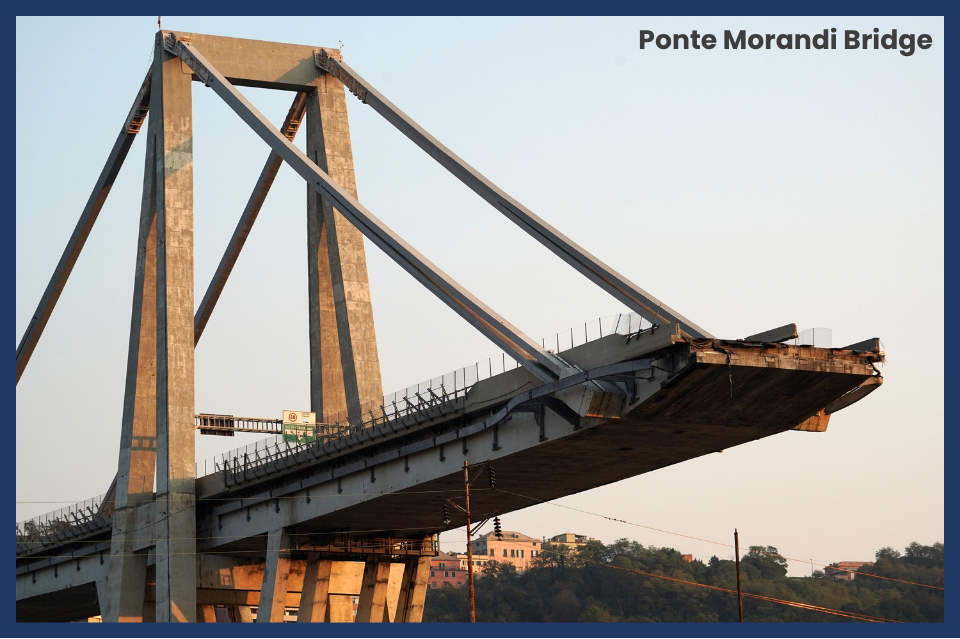
On 14 August 2018, a 300-metre section of Genoa’s Ponte Morandi bridge collapsed during a rainstorm, sending vehicles and tonnes of concrete around 45 metres to the ground below. Forty-three people lost their lives.
In the aftermath, attention quickly turned to what had gone wrong. The answer, however, was not as simple as a single failed component or one extreme weather event.

A bridge with known problems
Completed in 1967, the Ponte Morandi was an unusual cable-stayed bridge. It stays used steel tendons encased in prestressed concrete, rather than the exposed steel cables more commonly used today. There were also only two stays per tower, meaning there was less redundancy if one structural element failed.
The concrete encasement created another challenge: it made the condition of the steel underneath difficult to inspect. Corrosion was already a concern, particularly given Genoa’s exposure to sea air and industrial pollution.
The bridge also required significant maintenance almost from the beginning. In 1979, its designer Riccardo Morandi recommended ongoing maintenance to address exposed reinforcement and rust.
Engineer Antonio Bercich was interviewed about the bridge’s design in 2016 by ingegneri.info. Bercich called the bridge a “failure of engineering” in his report and said that the costs of maintenance would be more than the costs of building a whole new bridge.
By 2017, a study had identified anomalies in the way some of the stays responded to vibration. Stefano Della Torre, who led the department involved in the study, later told Reuters: “The study highlighted an anomaly and recommended investigating the matter further.”
The warning signs were numerous
The collapse has since been examined through several lenses, including design, construction quality, corrosion, maintenance, traffic volumes, age and environmental conditions.
There were also questions about how much traffic the bridge was carrying compared with what it was originally designed for. According to the information provided, traffic had grown to more than ten times the expected level.
Testimony during the later trial indicated that concerns about the bridge's safety had been raised years before the collapse.
Gianni Mion, a former highways company executive, told the trial that in 2010 he was informed there was an original design defect and a risk of collapse. “It emerged that the bridge had an original design defect and that there was a collapse risk,” he said, “I should have done something about it, but I didn't.”

What actually happened
At approximately 11:36 am on 14 August 2018, during a period of heavy rain and thunderstorms, a supporting cable stay on Tower 9 failed. This was one of the bridge's three main supporting towers.
The cable stays were critical to the bridge's structural stability, transferring loads between the towers and the roadway. When one of these stays failed, the structure lost an important part of its support and balance. The road deck began to collapse, followed by the supporting tower and surrounding sections of the bridge.
Around 200 metres of the elevated roadway came down, sending cars and trucks plunging approximately 45 metres onto the streets, railway lines and industrial areas below. Nearby buildings were also damaged, and residents were forced to evacuate.
Forty-three people lost their lives.
While the thunderstorm initially attracted attention as a possible cause, subsequent investigations identified corrosion in the steel tendons within the concrete-encased stays as a critical factor. The deterioration had weakened a component essential to the bridge's stability, with inadequate inspections and maintenance also identified as contributing factors.
What changed after the collapse?
The disaster prompted Italy to reconsider how it assessed and managed its existing bridge infrastructure.
In 2020, the Italian government introduced national guidelines for the classification, assessment and monitoring of existing bridges. The framework established a more consistent approach to inspections and risk management, moving away from relying on individual bridge owners and operators to determine their own assessment methods.
Updated in 2022, the guidelines introduced a multi-level assessment process that considers factors including structural condition, environmental hazards and the potential consequences of failure. Bridges are assigned a risk classification, or 'class of attention', which helps determine whether further investigation is needed and what maintenance or safety interventions should be prioritised.
Importantly, this provided a uniform national method for assessing bridges, helping authorities identify potential problems and allocate resources according to risk rather than waiting for deterioration to become critical.

What we can learn from the disaster
The collapse highlights the importance of looking at infrastructure as a long-term system rather than something that is simply designed, built and handed over. Design choices affect how easily a structure can be inspected decades later, while maintenance, increasing traffic and changing environmental conditions all need to be considered as infrastructure ages.
It also demonstrates why consistent inspection frameworks, reliable reporting and clear accountability matter. Warning signs need to be investigated, risks need to be communicated and, most importantly, decisions need to be followed by action.
The replacement Ponte Morandi, designed by Genoa-born architect Renzo Piano, opened in August 2020. Its design and construction incorporated extensive digital modelling and a digital twin to support coordination, accuracy and future maintenance.
Ultimately, the lesson is that infrastructure safety requires more than good initial design. It relies on ongoing investment, informed decision-making and a willingness to act when something isn't right.
All images sourced from Canva.


Comments